DIETARY SUPPLEMENTS

Découvrez 08 - Slim
Your ally for a slimmer figure and healthy weight

Journal
Inflammation is a normal biological process.
It allows the body to defend itself, repair tissues, and respond to external stressors. In the short term, it is essential.
The issue arises when inflammation becomes chronic, low-grade, and persistent.
This condition—known as chronic low-grade inflammation—is now recognized as a major driver of numerous health issues:
— metabolic disorders (weight gain, insulin resistance, type 2 diabetes)
— cardiovascular disease (atherosclerosis, hypertension)
— digestive disorders (bloating, irritable bowel)
— skin conditions (acne, rosacea, premature aging)
— chronic fatigue
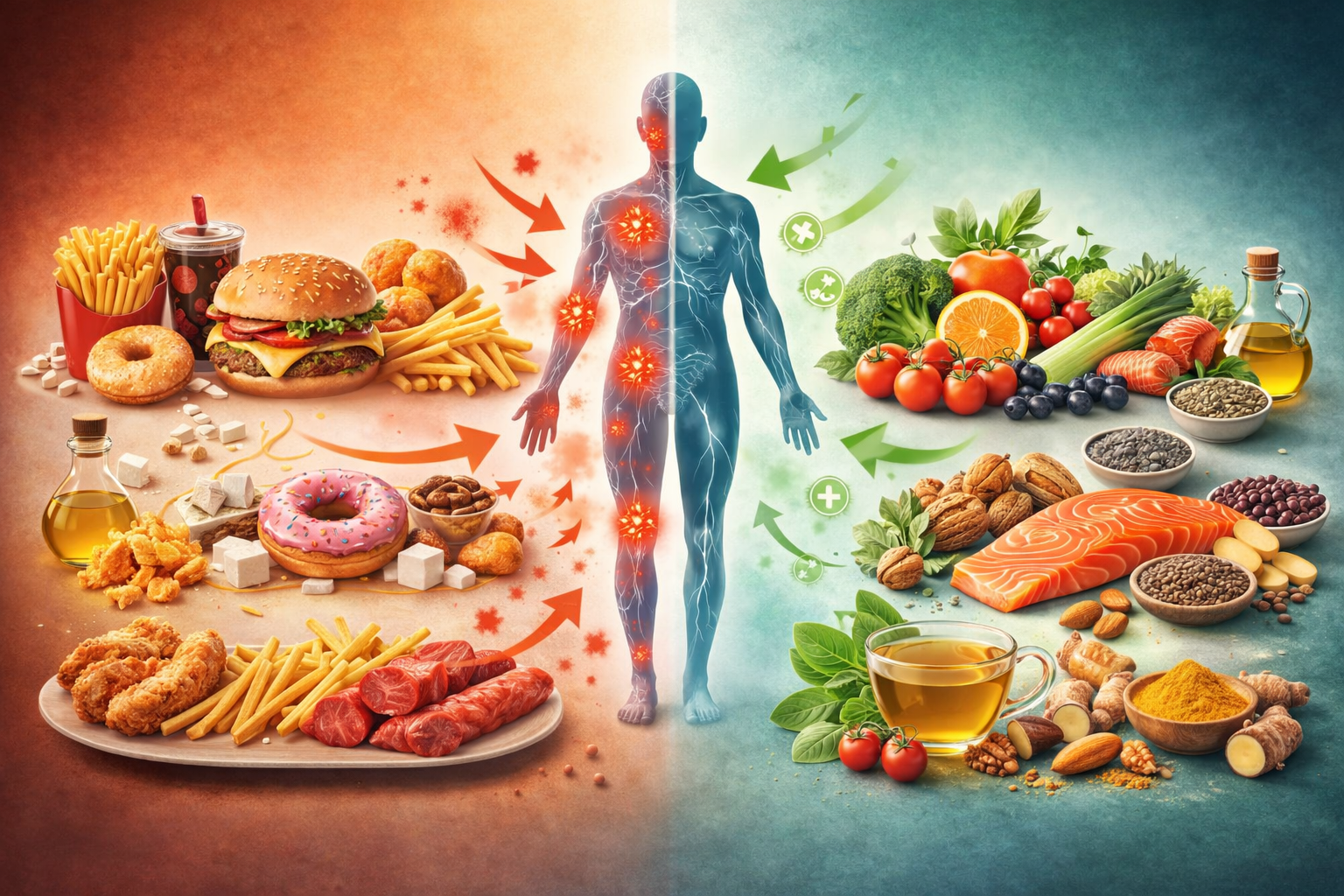
Among the factors that influence inflammation, diet plays a central role.
Unlike acute inflammation, low-grade inflammation does not produce obvious symptoms.
It develops gradually, driven by repeated signals:
— excess sugar (pastries, sodas, sweet snacks)
— ultra-processed foods (ready meals, refined cereals, sugary bars)
— imbalanced fats (refined vegetable oils, repeated frying)
— gut microbiome disruption (low fiber intake, excess alcohol)
— chronic stress and poor sleep
Biologically, it is reflected by a mild but persistent elevation of inflammatory markers such as CRP and cytokines [1].
This chronic inflammation disrupts:
— insulin sensitivity (promoting abdominal fat storage)
— mitochondrial function (fatigue, low energy)
— hormonal regulation (cravings, imbalance)
— gut microbiome stability
It creates a metabolic environment that favors fat storage, fatigue, and systemic imbalance.
A “pro-inflammatory” diet is not defined by a single food, but by repeated nutritional signals.
The main drivers include:
Repeated blood sugar spikes (white bread, pastries, sugary cereals, fruit juices) promote:
— insulin release
— oxidative stress
— activation of inflammatory pathways
They also contribute to the formation of advanced glycation end products (AGEs), which are linked to cellular aging [2].
Ultra-processed foods often combine:
— refined sugars (sodas, packaged desserts)
— low-quality fats (fast food, ready meals)
— additives (emulsifiers, preservatives)
Examples: frozen pizzas, chicken nuggets, chips, packaged sauces, breakfast cereals.
A controlled clinical trial showed that diets high in ultra-processed foods lead to increased calorie intake and weight gain [3].
They are also associated with higher levels of systemic inflammation [4].
An excess of omega-6 fatty acids (sunflower oil, corn oil, soybean oil, processed foods) combined with insufficient omega-3 intake promotes a pro-inflammatory state.
Examples:
— frequent consumption of fried or processed foods
— lack of fatty fish (salmon, sardines, mackerel)
This imbalance is well documented in the scientific literature [5].
A diet low in fiber and high in processed foods alters gut microbiota composition.
Examples:
— low intake of vegetables and legumes
— high intake of refined grains (white bread, white pasta)
— minimal dietary fiber
This can lead to:
— increased intestinal permeability
— immune system activation
— chronic inflammation
The link between gut health and inflammation is now firmly established [6].
An anti-inflammatory diet is not built around a single “superfood,” but around overall dietary coherence.
Its goal is to reduce inflammatory signals and restore a stable cellular environment.
Diets rich in whole foods (fruits, vegetables, legumes, whole grains) are associated with reduced inflammatory markers [7].
Examples:
— leafy greens (spinach, broccoli, zucchini)
— polyphenol-rich fruits (berries, pomegranate)
— legumes (lentils, chickpeas)
— whole grains (brown rice, quinoa, whole-grain bread)
These foods provide:
— fiber
— polyphenols
— essential micronutrients
Polyphenols (green tea, berries, ≥70% dark chocolate, extra virgin olive oil) help regulate:
— oxidative stress
— inflammatory gene expression
— cellular signaling
Examples:
— matcha green tea
— blueberries, raspberries
— dark chocolate ≥70% cocoa
— cold-pressed olive oil
They play a key role in inflammation control [8].
Adequate omega-3 intake (fatty fish, walnuts, flaxseeds, chia seeds) helps:
— reduce inflammation
— improve insulin sensitivity
— modulate cytokine activity
Examples:
— salmon, sardines, mackerel
— walnuts, almonds
— flaxseed or canola oil
These effects are well supported by scientific evidence [9].
Dietary fiber feeds the gut microbiome and promotes the production of anti-inflammatory compounds (short-chain fatty acids).
Examples:
— vegetables (artichokes, leeks, carrots)
— fruits (apples, pears)
— legumes (lentils, beans)
— whole grains
High-fiber diets are associated with reduced systemic inflammation [10].
The effect of a single food cannot be isolated from the broader dietary pattern.
A diet becomes pro- or anti-inflammatory through the accumulation of signals.
Examples:
— sugary breakfast + processed lunch + low-fiber dinner → pro-inflammatory pattern
— meals rich in vegetables, healthy fats, and quality protein → anti-inflammatory pattern
What matters most:
— consistency over time
— overall dietary coherence
— nutrient balance
From a Cellular Nutrition® perspective, inflammation is not an isolated symptom.
It reflects an imbalance across multiple systems:
— gut microbiome (disrupted by low fiber intake)
— mitochondria (impaired by oxidative stress)
— metabolism (unstable blood sugar)
— immune system (chronically activated)
The goal is not simply to “reduce inflammation,”
but to restore the biological conditions that regulate it.
AGE acts on several pathways involved in inflammation:
— oxidative stress regulation (polyphenols)
— cellular repair support
— modulation of inflammatory signaling
These compounds interact with key cellular pathways involved in inflammation and aging [8].
OPTIMAL works upstream:
— mitochondrial energy production
— stress regulation
— gut microbiome balance
Examples:
— adaptogens for stress resilience
— probiotics for gut support
— energy cofactors
A fatigued or imbalanced system is more prone to chronic inflammation.
Inflammation is closely tied to metabolic function.
SLIM targets:
— insulin sensitivity
— blood sugar regulation
— gut microbiome
Examples of effects:
— reduced sugar cravings
— more stable glucose levels
— improved metabolic efficiency
Compounds such as berberine have been shown to modulate metabolic inflammation via AMPK activation [11].
The distinction between pro- and anti-inflammatory diets is not about strict rules or forbidden foods.
It reflects a deeper biological reality:
your body constantly responds to the signals you provide.
Some promote inflammation.
Others help regulate it.
Simple examples:
— processed, low-fiber diets → chronic inflammation
— fiber-rich, polyphenol-rich, balanced diets → regulation
Over time, this balance shapes health, resilience, and aging trajectory.
[1] Furman D et al. Chronic inflammation in the etiology of disease. Nature Medicine.
https://www.nature.com/articles/s41591-019-0675-0
[2] Singh VP et al. Advanced glycation end products and inflammation.
https://pubmed.ncbi.nlm.nih.gov/23628166/
[3] Hall KD et al. Ultra-processed diets and weight gain. Cell Metabolism.
https://pubmed.ncbi.nlm.nih.gov/31269427/
[4] Srour B et al. Ultra-processed foods and inflammation. BMJ.
https://pubmed.ncbi.nlm.nih.gov/31142450/
[5] Simopoulos AP. Omega-6/omega-3 ratio and inflammation.
https://pubmed.ncbi.nlm.nih.gov/12442909/
[6] Cryan JF et al. Microbiota–gut–brain axis. Physiological Reviews.
https://pubmed.ncbi.nlm.nih.gov/30309968/
[7] Mediterranean diet and inflammation markers.
https://pubmed.ncbi.nlm.nih.gov/18326600/
[8] Polyphenols and inflammation.
https://pubmed.ncbi.nlm.nih.gov/20156556/
[9] Omega-3 fatty acids and inflammation.
https://pubmed.ncbi.nlm.nih.gov/12442909/
[10] Dietary fiber and inflammation.
https://pubmed.ncbi.nlm.nih.gov/25769363/
[11] Hardie DG. AMPK and inflammation.
https://pubmed.ncbi.nlm.nih.gov/26070754/