DIETARY SUPPLEMENTS

Découvrez 08 - Slim
Your ally for a slimmer figure and healthy weight

Journal
There’s a deeply ingrained belief that skin simply ages over time — a gradual, inevitable, almost linear process. And yet, in reality, some skin appears to age faster than others, regardless of chronological age. Loss of radiance, sagging, more pronounced wrinkles, uneven texture — these changes are not just the result of time passing. They reflect specific, often invisible biological mechanisms that accelerate skin aging.
Because skin doesn’t age only at the surface. It ages through deeper cellular processes, where metabolism, environmental exposure, and biochemical signaling continuously interact. Three key mechanisms play a central role in this acceleration: glycation, UV exposure, and mitochondrial dysfunction.
Glycation is largely invisible, yet fundamental. It is a non-enzymatic reaction between sugars and proteins — particularly collagen. This interaction leads to the formation of compounds known as AGEs (Advanced Glycation End Products), which significantly alter tissue structure [1].
This is not just a functional disruption. Glycation physically transforms collagen. Fibers become stiffer, less flexible, and progressively lose their ability to maintain skin structure. The process is irreversible. Over time, the accumulation of AGEs leads to reduced elasticity, deeper wrinkles, and an overall decline in skin quality.
A simple example makes this clearer. A diet high in fast sugars — ultra-processed foods, sugary drinks, snacks — leads to repeated spikes in blood glucose. With each spike, the likelihood of glycation reactions increases. These reactions don’t produce immediate visible effects, but they accumulate. Gradually, collagen loses its flexibility, and the skin becomes duller, more rigid, and less resilient.
This mechanism helps explain why two individuals of the same age can have markedly different skin quality. Skin aging is not just about time — it is also about metabolic environment.
Ultraviolet exposure is one of the most well-documented drivers of skin aging. Unlike intrinsic aging, which is time-dependent, photoaging refers to accelerated aging caused by environmental factors — primarily UV radiation [2].
UV rays act at multiple levels. They cause direct DNA damage in skin cells, increase the production of reactive oxygen species (ROS), and trigger inflammatory cascades. These free radicals damage lipids, proteins, and cellular structures, creating an environment that promotes aging.
One of the most significant effects is the activation of enzymes known as matrix metalloproteinases (MMPs), which break down collagen. In other words, UV exposure doesn’t just damage the skin — it actively triggers the mechanisms that degrade its structure.
In everyday life, this plays out in subtle but cumulative ways. Repeated exposure — even moderate — such as walking in the city, sitting outside at lunch, or driving, without adequate protection, leads to a progressive buildup of damage. These effects are not immediately visible, but they become apparent over time: deeper wrinkles, loss of firmness, uneven pigmentation.
UV-related aging is not simply “faster aging.” It is a different type of aging — more disorganized, more inflammatory, and often more difficult to reverse.
Beyond these visible factors, a more fundamental mechanism is at play: mitochondrial function. These organelles, present in every cell, are responsible for energy production, but also for regulating oxidative stress and numerous cellular signals.
Over time — and under the influence of stress, inflammation, and environmental exposure — mitochondrial efficiency declines. Energy production decreases, while the production of free radicals increases. This imbalance promotes cellular damage, impairs repair mechanisms, and accelerates aging [3][4].
In the skin, this results in slower cellular turnover, reduced collagen production, and a gradual loss of tissue quality. Mitochondria are not simply “energy factories” — they are central to cellular balance and longevity.
These three mechanisms do not operate in isolation. They are deeply interconnected.
UV exposure increases oxidative stress, which damages mitochondria. Dysfunctional mitochondria produce more free radicals, further amplifying cellular damage. At the same time, an unstable metabolic environment — characterized by repeated blood sugar fluctuations — promotes glycation, which stiffens skin structures and exacerbates aging.
In other words, accelerated skin aging is not driven by a single factor. It is the result of a broader imbalance, where metabolism, environment, and cellular function gradually become dysregulated.
Reducing skin aging to skincare routines or surface-level interventions is a limited perspective. Skin quality depends first and foremost on how cells function, regenerate, and interact with their environment.
Glycation, oxidative stress, inflammation, mitochondrial function — these mechanisms form a complex network that determines how skin evolves over time. This is precisely the integrated perspective behind Cellular Nutrition®. Not correcting visible signs, but understanding the biological processes that drive them.
Because skin that ages faster is not simply “tired” skin. It is skin whose fundamental mechanisms are compromised. And that is where the real difference lies.
Understanding the mechanisms of skin aging is a first step. The next question becomes more practical: how can these processes be addressed in a coherent and lasting way?
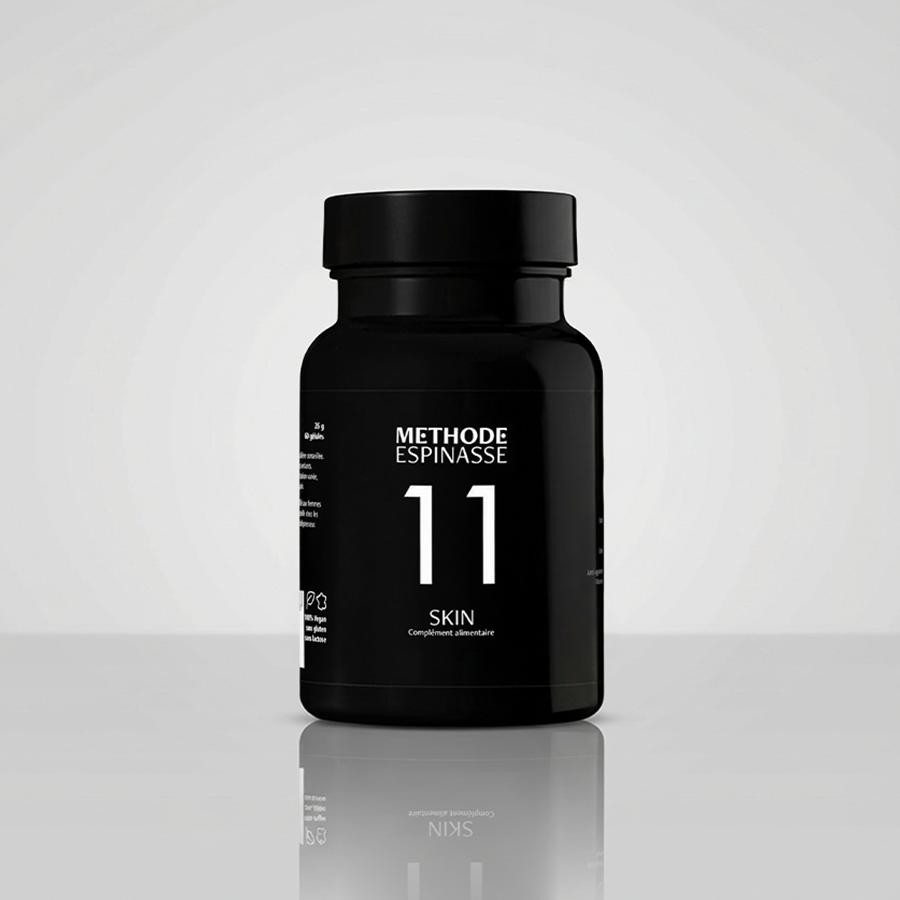
Within this framework, certain approaches aim to move beyond surface-level cosmetics and act directly on the biological foundations of the skin. This is precisely the rationale behind the SKIN protocol, developed as part of Cellular Nutrition®.
Formulated by Dr. Espinasse, SKIN is designed to act deeply on the dermal matrix by targeting several key mechanisms involved in skin aging simultaneously: hydration, structural integrity, oxidative stress, and inflammation.
Its formulation combines hyaluronic acid, hydrolyzed marine collagen, astaxanthin, and targeted probiotics. These ingredients were selected for their complementary and synergistic effects. Hyaluronic acid supports water retention within the extracellular matrix, promoting deeper and more sustained hydration. Hydrolyzed marine collagen helps support dermal structure by creating a biological environment conducive to endogenous collagen production, which is essential for firmness and elasticity.
Astaxanthin acts on another critical level by limiting oxidative stress, particularly that induced by UV exposure. This is a key point: free radicals generated by UV exposure directly contribute to collagen degradation and mitochondrial damage. By acting on these mechanisms, astaxanthin helps preserve cellular integrity.
Finally, the inclusion of targeted probiotics supports the gut–skin axis. By modulating low-grade inflammation and supporting microbiome balance, this approach contributes to improving overall skin quality, particularly in contexts of sensitivity, inflammation, or inflammaging.
This type of formulation reflects an integrative approach. Rather than targeting a single symptom, it aims to support the biological mechanisms that determine how the skin evolves over time. Deep hydration, extracellular matrix cohesion, antioxidant protection, and inflammation regulation — these axes directly address the processes involved in loss of firmness, collagen degradation, and accelerated skin aging.
In practice, this type of protocol is particularly relevant for skin affected by dehydration, loss of elasticity, oxidative stress, or repeated environmental exposure such as UV radiation or pollution. It fits within a broader strategy aimed at supporting skin density, texture, and radiance — not at the surface, but at the level of its biological foundations.
[1] Zheng W., Fan W., Zhang M. et al. (2022)
Research Advances on the Damage Mechanism of Glucose and Its Glycation Products on Skin
Clinical, Cosmetic and Investigational Dermatology
https://pmc.ncbi.nlm.nih.gov/articles/PMC9655929/
[2] Rittié L., Fisher G.J. (2015)
UV-light-induced signal cascades and skin aging
Ageing Research Reviews
https://pmc.ncbi.nlm.nih.gov/articles/PMC4842382/
[3] Quan C., Cho M.K., Perry D., Quan T. (2020)
Age-associated reduction of cell spreading and mitochondrial function in human skin
Cell Death & Disease (Nature Publishing Group)
https://www.nature.com/articles/s41419-020-2649-z
[4] Wang Y., Hekimi S. (2025)
Mitochondrial dysfunction and oxidative stress in aging
Signal Transduction and Targeted Therapy (Nature)
https://www.nature.com/articles/s41392-025-02253-4