DIETARY SUPPLEMENTS

Découvrez 08 - Slim
Your ally for a slimmer figure and healthy weight

Journal
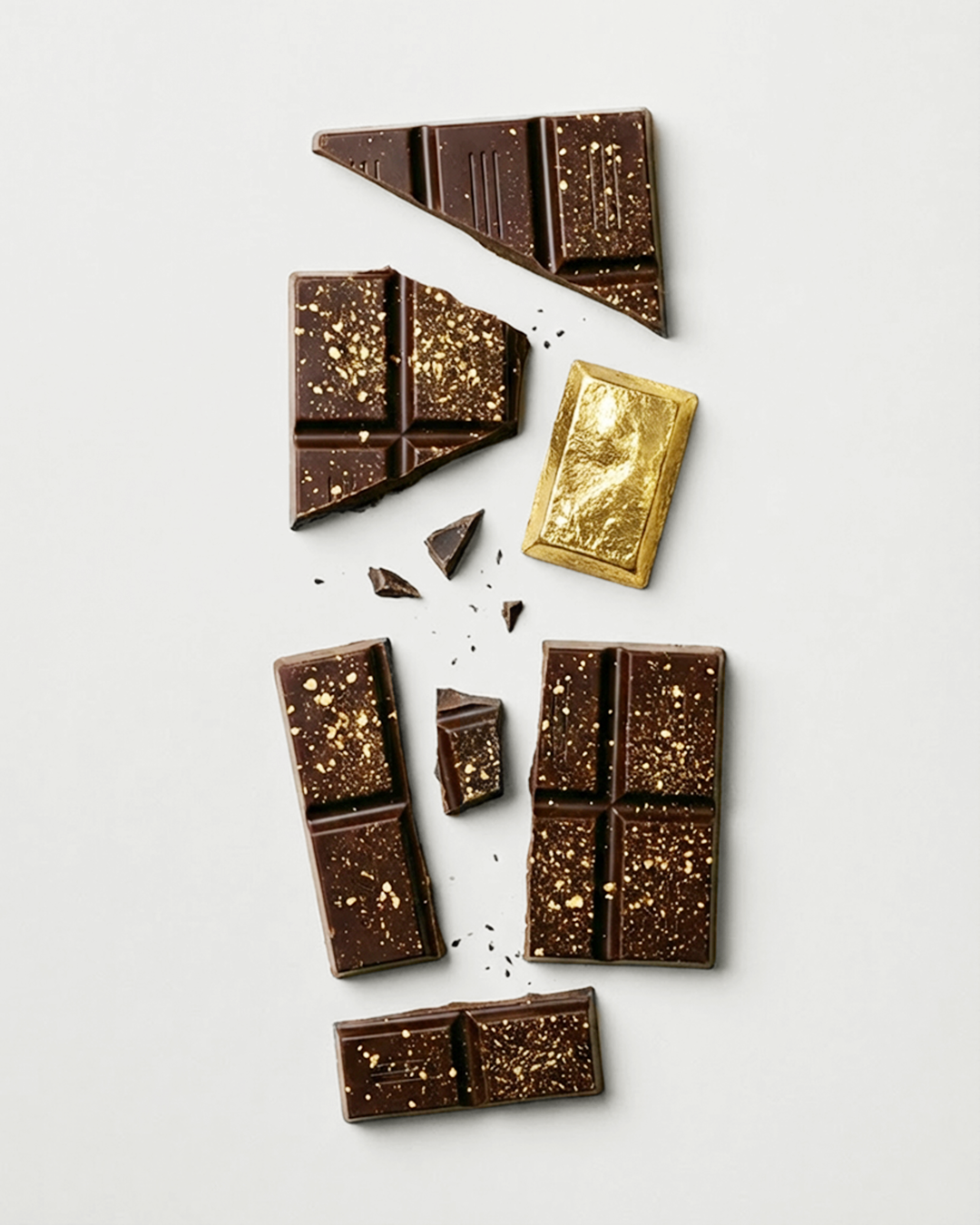
Chocolate occupies a uniquely ambiguous place in modern nutrition.
At once associated with pleasure, indulgence, and excess, it is often viewed as something to limit—or even avoid—when it comes to weight management, metabolic health, or skin concerns.
Yet this perception is overly simplistic.
The scientific reality is far more nuanced: chocolate is not a single, uniform food. Its effects depend directly on its composition, cocoa content, and level of processing.
The term “chocolate” covers a wide range of products.
Milk chocolate and most industrial chocolate-based products typically contain:
— high amounts of sugar
— added fats
— relatively low cocoa content
In contrast, dark chocolate with a high cocoa content (≥70%) offers a very different nutritional profile:
— rich in polyphenols
— lower in sugar
— higher nutrient density
This distinction is fundamental, as it directly determines its biological effects.
Cocoa is naturally rich in flavonoids, particularly flavanols such as epicatechin and catechin.
These compounds have been extensively studied for their effects on:
— vascular function
— inflammation
— oxidative stress
— insulin sensitivity
A meta-analysis published in The American Journal of Clinical Nutrition found that cocoa flavanols significantly improve endothelial function, a key marker of cardiovascular health [1].
Additional research suggests beneficial effects on blood pressure and metabolic markers [2].
Contrary to common belief, dark chocolate is not inherently linked to weight gain.
Some observational studies even associate moderate dark chocolate consumption with lower body mass index (BMI) [3].
These effects may be explained by several mechanisms:
— enhanced satiety from polyphenols
— improved appetite regulation
— modulation of the gut microbiome
— effects on insulin sensitivity
However, these benefits are specific to high-cocoa chocolate consumed in moderate amounts.
Dark chocolate ≥70% has a unique behavioural effect: it tends to self-regulate consumption.
Its intensity, slight bitterness, and nutritional density encourage slower eating and naturally smaller portions.
By contrast, sugar-rich chocolate products are more likely to be consumed quickly and in larger quantities.
A study comparing dark and milk chocolate found that dark chocolate increased satiety and reduced cravings for sweet foods [4].
This is a key point: the impact of chocolate is not just biochemical—it is behavioural.
Cocoa polyphenols interact directly with the gut microbiota.
They promote the growth of beneficial bacteria involved in:
— inflammation regulation
— energy metabolism
— gut health
Research published in Frontiers in Nutrition shows that flavanol-rich cocoa can positively alter microbiome composition [5].
These effects may contribute indirectly to improved metabolic balance.
Chocolate is often blamed for breakouts and skin issues.
In reality, scientific evidence does not support a direct link between dark chocolate and acne.
Observed negative effects are more closely associated with:
— high sugar intake
— high glycaemic diets
Cocoa itself contains anti-inflammatory and antioxidant compounds that may support skin health [6].
As with most foods, the benefits of chocolate depend on balance.
Current evidence suggests that moderate consumption—typically around 10 to 20 grams of high-cocoa dark chocolate per day—can be included in a healthy diet without negative effects on weight or metabolism.
Beyond that, total caloric intake becomes a relevant factor.
The benefits outlined here apply to a specific type of chocolate:
— dark chocolate with ≥70% cocoa
— ideally ≥80% for higher polyphenol content
— low in added sugars
— minimally processed
The higher the cocoa content, the greater the concentration of bioactive compounds.
Chocolate is neither an enemy nor a universal superfood.
Scientific evidence shows that:
— high-cocoa dark chocolate contains biologically active compounds
— its effects depend strongly on composition
— sugar content is a key determinant
— moderation remains essential
When consumed in its most refined form—high in cocoa and minimally processed—chocolate can be part of a balanced, metabolically coherent approach to nutrition.
[1] Hooper L et al. Flavonoids and cardiovascular health. Am J Clin Nutr.
https://pubmed.ncbi.nlm.nih.gov/22552032/
[2] Ried K et al. Effect of cocoa on blood pressure. Cochrane Review.
https://pubmed.ncbi.nlm.nih.gov/23450570/
[3] Golomb BA et al. Chocolate consumption and BMI. Arch Intern Med.
https://pubmed.ncbi.nlm.nih.gov/22493477/
[4] Sørensen LB et al. Dark vs milk chocolate and appetite.
https://pubmed.ncbi.nlm.nih.gov/20089021/
[5] González-Sarrías A et al. Cocoa and gut microbiota. Frontiers in Nutrition.
https://pubmed.ncbi.nlm.nih.gov/28459078/
[6] Nichols JA, Katiyar SK. Skin photoprotection and polyphenols.
https://pubmed.ncbi.nlm.nih.gov/18296356/