DIETARY SUPPLEMENTS

Découvrez 08 - Slim
Your ally for a slimmer figure and healthy weight

Journal
Weight loss has never been more misunderstood.
For decades, the dominant narrative has been simple: eat less, move more. Yet modern research tells a very different story. Weight gain — especially stubborn, resistant weight gain — is not primarily a question of calories. It is a question of biology.
More specifically: it is a question of how your cells respond to energy.
Today, leading research in metabolism, longevity science, and systems biology converges on a central idea: fat loss is regulated at the cellular level — through pathways that control insulin sensitivity, mitochondrial function, inflammation, and nutrient sensing (AMPK, mTOR) [1][2].
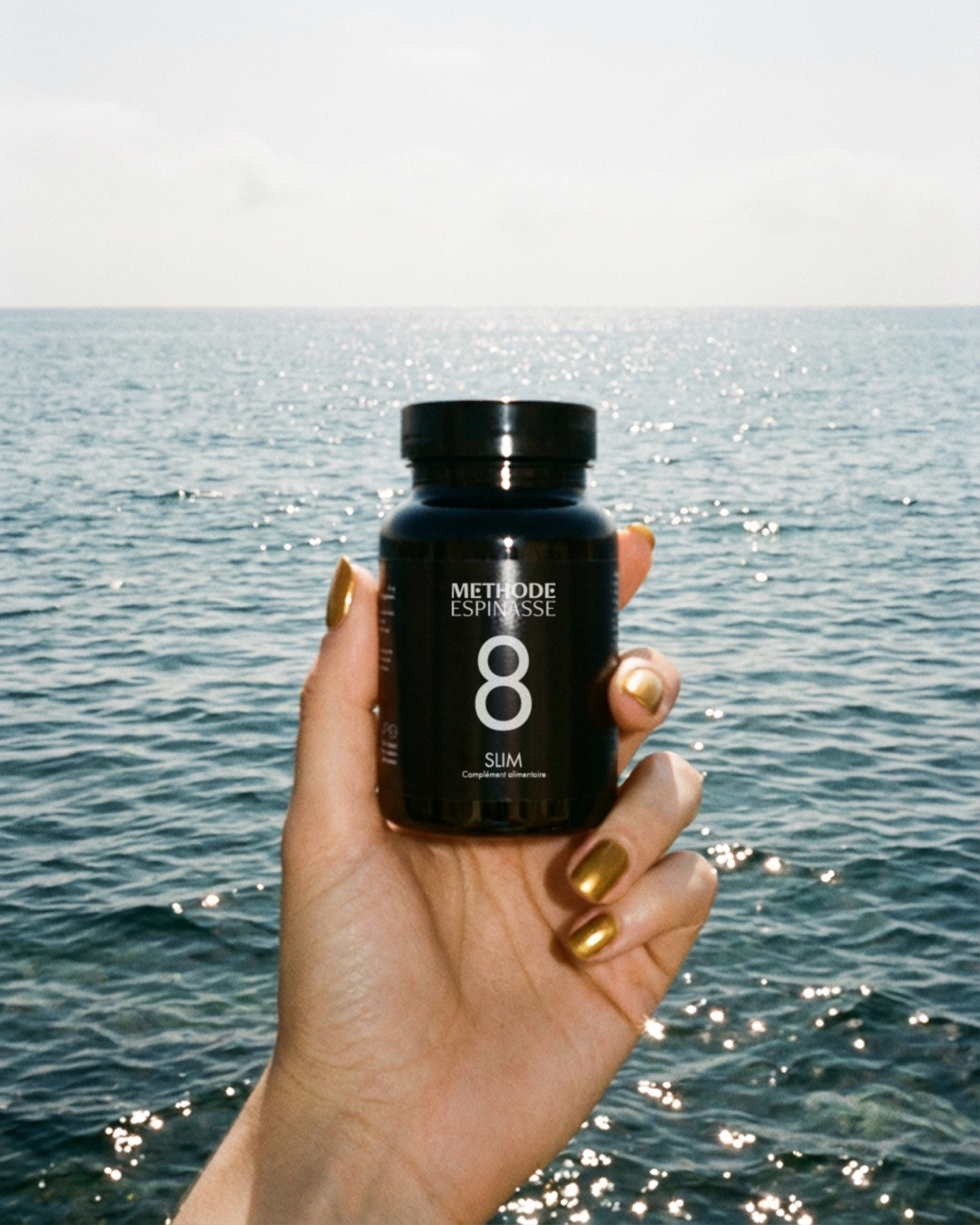
This is exactly where the Cellular Nutrition® protocol N°8 SLIM operates.
Not as a quick fix. But as a targeted, science-driven strategy designed to restore metabolic function — and unlock sustainable fat loss.
If you feel like you’re doing everything “correctly” — eating well, exercising, cutting calories — yet the weight won’t budge, you are not alone.
And more importantly: you are not the problem.
The issue is metabolic.
Modern research shows that weight resistance is often driven by a combination of:
— impaired insulin sensitivity
— unstable blood sugar regulation
— reduced metabolic flexibility
— chronic low-grade inflammation
— altered gut microbiome composition
— decreased mitochondrial efficiency
When these systems are dysregulated, your body shifts into a state where:
— fat storage is favored
— fat oxidation is reduced
— hunger signals increase
— energy levels drop
This is not a willpower issue. It is a cellular signaling issue [2].
Cellular Nutrition® is a science-based framework that redefines how we approach metabolism, weight, and health.
Instead of focusing only on what you eat, it focuses on what your cells do with it.
Because nutrients are not just fuel. They are biological signals.
They directly influence key pathways such as:
— AMPK (energy sensing and fat oxidation)
— mTOR (growth and storage signaling)
— mitochondrial ATP production
— inflammatory pathways (NF-κB)
— gut–metabolism interactions
This shift is critical.
It means that effective weight loss is not about restriction — it is about restoring the body’s ability to use energy correctly [3].
The Cellular Nutrition® protocol N°8 SLIM is designed to target the three core biological drivers of weight gain:
Rather than acting on one isolated pathway, N°8 SLIM integrates multiple mechanisms — metabolic, hormonal, and gut-related — into a single, coherent strategy.
Unstable blood sugar is one of the most underestimated drivers of weight gain.
Frequent glucose spikes trigger repeated insulin responses, promoting fat storage and increasing cravings — especially for sugar [4].
This is where berberine, one of the key actives in N°8 SLIM, plays a central role.
Recent meta-analyses show that berberine improves:
— fasting glucose
— insulin sensitivity
— inflammatory markers
Its mechanism is closely linked to the activation of AMPK, a key energy sensor that promotes fat utilization and metabolic balance [5].
Complementing this, Gymnema sylvestre has been shown to:
— reduce sugar cravings
— modulate glucose absorption
— improve glycemic control
Some studies even suggest it can directly reduce preference for sweet taste, making it a powerful tool for breaking sugar dependency patterns [6].
Together, these mechanisms address one of the root causes of weight gain:
loss of glycemic control.
Not all fat is equal.
Visceral fat — the fat stored around internal organs — is metabolically active and strongly associated with inflammation, insulin resistance, and metabolic disease [7].
Emerging research highlights a critical player in this process: the gut microbiome.
Certain bacterial profiles are associated with increased fat storage and systemic inflammation.
This is where Lactobacillus gasseri, included in N°8 SLIM, stands out.
Clinical studies have shown that specific strains of L. gasseri can:
— reduce abdominal fat
— decrease waist circumference
— lower visceral fat area (measured by imaging)
In some trials, visceral fat reduction reached up to 8% over 12 weeks [8].
This positions the microbiome not as a secondary factor — but as a central regulator of metabolic health.
One of the defining features of metabolic dysfunction is the inability to efficiently switch between fuel sources — a condition known as metabolic inflexibility.
In this state, the body struggles to burn fat, even when energy intake is reduced.
The Cellular Nutrition® approach aims to restore this flexibility.
Coleus forskohlii, included in N°8 SLIM, has been associated with improvements in body composition, including reductions in fat mass in controlled trials [9].
Meanwhile, green tea catechins have demonstrated modest but consistent effects on:
— body weight
— BMI
— body fat percentage
These effects are thought to involve increased fat oxidation and thermogenesis [10].
Individually, these effects are moderate. But together, they contribute to a metabolic environment favorable to fat loss.
Chronic, low-grade inflammation — often referred to as inflammaging — plays a critical role in metabolic dysfunction.
It interferes with insulin signaling, impairs mitochondrial function, and promotes fat storage [11].
This inflammation is closely linked to:
— poor diet quality
— gut dysbiosis
— excess visceral fat
By simultaneously targeting glycemic control, gut health, and metabolic signaling, N°8 SLIM contributes to reducing this inflammatory background — creating the conditions necessary for sustainable fat loss.
Most supplements focus on a single mechanism:
— appetite suppression
— thermogenesis
— water loss
This reductionist approach ignores the complexity of human metabolism.
As a result, outcomes are often short-lived — or nonexistent.
The difference with N°8 SLIM lies in its systems-level approach:
it does not try to override biology. It works with it.
The Cellular Nutrition® protocol N°8 SLIM is not designed as a quick fix.
It is designed to:
— restore metabolic balance
— stabilize energy regulation
— reduce cravings at their source
— improve fat utilization
— support gut–metabolism interactions
This is what allows fat loss to become sustainable, rather than reactive.
If weight loss were only about calories, it would be simple. It isn’t.
It is about how your body processes energy — at the cellular level.
The latest science is clear: fat loss depends on metabolic signaling, mitochondrial function, glycemic control, inflammation, and the gut microbiome.
The Cellular Nutrition® protocol N°8 SLIM is built precisely around these mechanisms.
Not to force weight loss. But to make it biologically possible again.
[1] López-Otín et al. Hallmarks of Aging. Cell. 2023.
https://pubmed.ncbi.nlm.nih.gov/36599349/
[2] Tomteelnganbee et al. Mitochondrial Function and Metabolism. Ageing Research Reviews. 2022.
https://pubmed.ncbi.nlm.nih.gov/35842501/
[3] Saxton & Sabatini. mTOR Signaling. Cell. 2017.
https://pubmed.ncbi.nlm.nih.gov/28283069/
[4] Insulin Resistance Review.
https://pubmed.ncbi.nlm.nih.gov/29904145/
[5] Berberine Meta-analysis.
https://www.sciencedirect.com/science/article/abs/pii/S0149291823004290
[6] Gymnema Sylvestre Review.
https://pubmed.ncbi.nlm.nih.gov/34467577/
[7] Ferrucci & Fabbri. Inflammation and Metabolism.
https://pubmed.ncbi.nlm.nih.gov/30065258/
[8] Kadooka et al. Lactobacillus gasseri Study.
https://pubmed.ncbi.nlm.nih.gov/20216555/
[9] Coleus forskohlii Trial.
https://pmc.ncbi.nlm.nih.gov/articles/PMC2129145/
[10] Green Tea Meta-analysis.
https://www.cambridge.org/core/journals/british-journal-of-nutrition/article/effects-of-green-tea-extract
[11] Chronic Inflammation Review.
https://pubmed.ncbi.nlm.nih.gov/30065258/