DIETARY SUPPLEMENTS

Découvrez 08 - Slim
Your ally for a slimmer figure and healthy weight

Journal
What if healthier aging depended, in part, on our cells’ ability to get rid of mitochondria that no longer work as well as they should?
Our cells contain thousands of mitochondria. Present in most cells throughout the body, mitochondria play a central role in energy production—but also in cellular signaling, metabolism, redox balance, and the response to stress.
Like every other component of the cell, mitochondria do not remain perfectly functional throughout our lifetime. Some can accumulate damage, become less efficient, or generate signals that interfere with normal cellular function.
Fortunately, our cells have quality-control systems capable of identifying and removing certain dysfunctional mitochondria.
One of these processes is called:
mitophagy.
And one molecule has attracted particular attention for its potential to influence this process:
urolithin A.
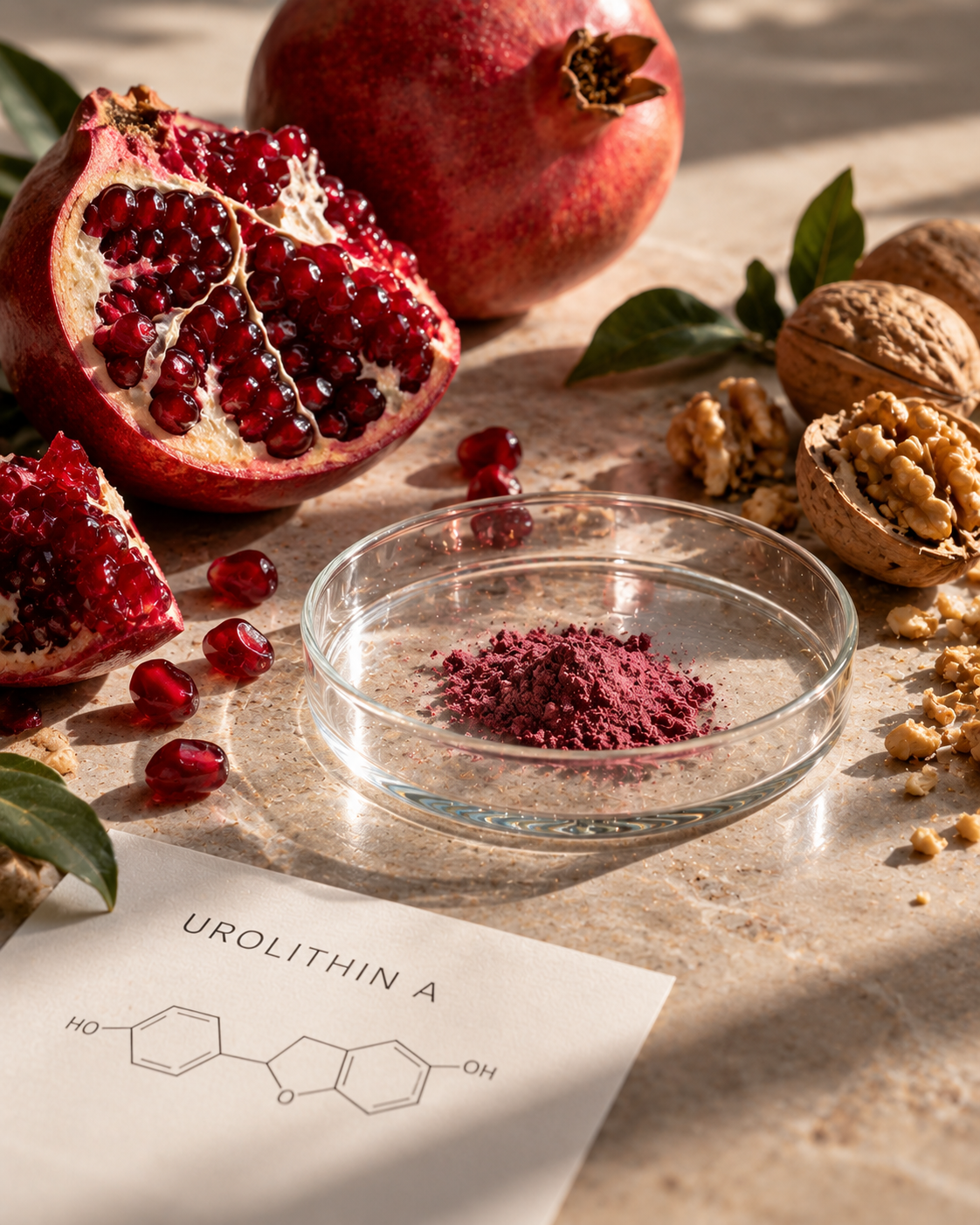
Urolithin A is not simply present in significant amounts in pomegranates or walnuts. Instead, it can be produced by certain gut bacteria from compounds found in these foods [1,2].
And not everyone produces it equally well.
That makes urolithin A a fascinating example of personalized nutrition: two people can eat exactly the same food and produce different metabolites from it.
But the scientific interest goes much further.
In 2016, a landmark study published in Nature Medicine showed that urolithin A could induce mitophagy, extend lifespan in C. elegans, and improve certain measures of muscle function in aging rodents [3].
Since then, several clinical trials have tested urolithin A directly in humans.
Which brings us to one of the most compelling questions in longevity research:
Can we actually “rejuvenate” our mitochondria by improving the way our cells recycle them?
To answer that, we first need to understand what mitochondria are—and what happens to them as we age.
Mitochondria are often described as:
“the powerhouses of the cell.”
It is a useful analogy, but an incomplete one.
Mitochondria do play a central role in producing ATP—adenosine triphosphate, one of the primary forms of usable energy in our cells.
Nutrients from food are progressively broken down, and electrons derived from this metabolism can feed into the mitochondrial respiratory chain, located within the inner mitochondrial membrane.
This chain creates a proton gradient that allows ATP synthase to generate ATP.
In highly simplified terms:
NUTRIENTS → ELECTRONS → RESPIRATORY CHAIN → PROTON GRADIENT → ATP
But mitochondria do far more than produce energy.
They are involved in lipid and amino acid metabolism, calcium signaling, the generation and regulation of reactive oxygen species, certain forms of programmed cell death, and numerous signaling pathways that help cells adapt to their environment.
Mitochondria are therefore better understood not simply as batteries, but as:
metabolic and signaling hubs.
Because mitochondrial biology changes as we age.
Depending on the tissue and the individual, aging is associated with changes in mitochondrial respiration, mitochondrial dynamics, mitochondrial DNA, quality-control mechanisms, and the ability to identify and remove damaged mitochondria.
Mitochondrial dysfunction is now recognized as one of the major biological hallmarks associated with aging.
That does not mean:
“Our mitochondria age, therefore we age.”
Human aging is far more complex.
But mitochondria are involved in so many fundamental processes that declining mitochondrial quality may be particularly important in tissues with high energy demands, including:
skeletal muscle, the brain, and the heart.
No.
Mitochondria are remarkably dynamic.
They can change shape, fuse with one another, divide, and exchange components. These processes of mitochondrial fusion and fission are part of a broader quality-control network.
A mildly impaired mitochondrion is therefore not automatically destined for destruction.
But when a mitochondrion becomes sufficiently dysfunctional, the cell may benefit from removing it.
That is where:
mitophagy
comes in.
Mitophagy is a specialized form of autophagy.
During autophagy, cells can capture intracellular material inside a membrane-bound structure known as an autophagosome. The autophagosome can then fuse with a lysosome, whose enzymes degrade the material inside.
Mitophagy applies this principle specifically to mitochondria.
In simplified terms:
DYSFUNCTIONAL MITOCHONDRION → RECOGNITION → AUTOPHAGOSOME → LYSOSOME → DEGRADATION / RECYCLING
The cell can therefore eliminate certain mitochondria it no longer needs and recycle some of their components.
This is not a mitochondrial “detox” or “cleanse” in the marketing sense.
It is a sophisticated form of:
intracellular quality control.
Autophagy is a broad term for cellular mechanisms that degrade and recycle intracellular material.
Mitophagy refers more specifically to the selective removal of mitochondria.
In simple terms:
AUTOPHAGY = broader intracellular recycling system
MITOPHAGY = selective recycling of mitochondria
That selectivity matters.
Cells obviously do not want to eliminate all of their mitochondria.
Instead, they need to maintain a balance between:
removing mitochondria that are no longer functioning adequately
and
maintaining or generating enough healthy mitochondria to meet cellular demands.
This broader network is known as mitochondrial quality control.
One of the best-studied mitophagy pathways involves two proteins:
PINK1 and Parkin.
In a healthy mitochondrion, PINK1 is normally imported into the mitochondrion and rapidly degraded.
But when a mitochondrion sufficiently loses its membrane potential, this process is disrupted. PINK1 can then accumulate on the outer mitochondrial membrane.
This accumulation helps recruit and activate Parkin, an E3 ubiquitin ligase.
Parkin then contributes to the addition of ubiquitin chains to various proteins on the mitochondrial membrane. These signals can be recognized by the autophagic machinery, helping target the mitochondrion for removal.
In simplified terms:
LOSS OF MITOCHONDRIAL MEMBRANE POTENTIAL → PINK1 → PARKIN → UBIQUITINATION → AUTOPHAGIC RECOGNITION → MITOPHAGY
This pathway is particularly well known because alterations in PINK1 and PRKN, the gene encoding Parkin, are associated with certain inherited forms of Parkinson’s disease.
But PINK1/Parkin is not the only mitophagy pathway.
Cells have multiple mechanisms for identifying and removing mitochondria.
The relationship between aging and mitophagy is complex and highly tissue-dependent.
It would therefore be far too simplistic to say:
“Mitophagy shuts down after age 50.”
It does not.
However, preclinical research suggests that aging can be associated with alterations in several mitochondrial quality-control mechanisms.
If the ability to remove damaged mitochondria becomes insufficient relative to the amount of damage being generated, less functional mitochondria may gradually accumulate.
This could contribute to an unfavorable biological cycle:
DAMAGED MITOCHONDRIA → METABOLIC DYSFUNCTION / CELLULAR STRESS → ADDITIONAL DAMAGE → INADEQUATE QUALITY CONTROL
This has led to an increasingly compelling idea in longevity science:
What if we could enhance mitophagy?
Urolithin A is a small molecule belonging to the urolithin family.
But despite the way some supplement labels might make it sound, urolithin A is not simply a nutrient found in food and absorbed directly in meaningful quantities.
Its story begins with another family of compounds:
ellagitannins.
Ellagitannins are polyphenols found in several plant foods, including:
During digestion, these compounds can release ellagic acid.
Ellagic acid itself has limited bioavailability.
A portion reaches the intestine, where certain bacteria can progressively transform it into different urolithins [1,2].
In other words, the gut microbiome performs a crucial part of the process.
The process can be summarized as:
ELLAGITANNINS → ELLAGIC ACID → GUT MICROBIOME → UROLITHINS → UROLITHIN A
Several bacterial species capable of contributing to different stages of this transformation have been identified, including species belonging to the genera Gordonibacter and Ellagibacter [1,2].
Once produced, urolithin A can be absorbed and undergo further metabolism, including conversion into glucuronide and sulfate conjugates.
That distinction matters.
Exposing cultured cells to a high concentration of free urolithin A in a laboratory dish does not necessarily reproduce the forms or concentrations to which human tissues are exposed after someone eats pomegranate.
This is one of the important translational limitations in the scientific literature [1,2].
No.
And this is one of the most fascinating aspects of the entire story.
The ability to produce different urolithins depends on the composition and metabolic activity of the gut microbiome.
Researchers have identified several profiles known as:
urolithin metabotypes [1,4].
Three broad patterns are generally described.
UM-A
These individuals primarily produce urolithin A as their final urolithin metabolite.
UM-B
These individuals produce urolithin A as well as isourolithin A and/or urolithin B.
UM-0
These individuals do not produce detectable amounts of the characteristic final urolithins after exposure to the precursors under the conditions studied.
This means two people can consume the same amount of pomegranate or walnuts and end up with:
very different internal exposure to urolithins.
It is an elegant example of:
precision nutrition.
Its distribution appears to change across the lifespan.
A study involving 839 individuals between 5 and 90 years of age found that age was strongly associated with the distribution of urolithin metabotypes [4].
Among children, UM-A predominated among urolithin producers. With increasing age, UM-B became more common, while the UM-0 phenotype was also present within the population.
This suggests that our ability to metabolize dietary polyphenols depends on more than:
what we eat.
It also depends on:
the microbial ecosystem metabolizing those compounds.
And that ecosystem changes over the course of our lives.
No.
This is a fundamental distinction.
When we eat pomegranates, walnuts, or certain berries, we consume ellagitannins and/or ellagic acid, along with many other nutrients and bioactive compounds.
The subsequent production of urolithin A depends on the gut microbiome.
Taking urolithin A directly largely bypasses this microbial conversion step.
That makes exposure more standardized and less dependent on an individual’s metabotype.
But it also means:
Studies of urolithin A supplementation are not studies of pomegranate.
And vice versa.
This distinction becomes particularly important when we look at clinical trials.
A 2016 study published in Nature Medicine played a major role in launching the current scientific interest in urolithin A [3].
Researchers first studied the compound in C. elegans, a tiny worm widely used in aging research.
Urolithin A induced biological mechanisms consistent with increased mitophagy and was associated with extended lifespan in these organisms [3].
But an equally interesting finding involved muscle function.
In aging rodents, urolithin A improved certain measures of muscle function and endurance [3].
The proposed model was compelling:
UROLITHIN A → MITOPHAGY → IMPROVED MITOCHONDRIAL QUALITY CONTROL → IMPROVED MUSCLE FUNCTION
But one point needs to be made immediately:
An improvement in a worm or a mouse does not demonstrate an anti-aging effect in humans.
The study established a mechanism and a hypothesis.
It did not establish a treatment for sarcopenia.
That is not the best way to describe its primary proposed mechanism.
Mitochondrial biogenesis refers to the processes involved in generating and expanding mitochondrial components and mitochondrial mass.
Mitophagy, by contrast, involves the selective removal of mitochondria.
They are therefore distinct processes:
MITOCHONDRIAL BIOGENESIS = building and renewing the mitochondrial network
MITOPHAGY = selectively removing certain mitochondria
Maintaining a healthy mitochondrial network requires coordination between the two.
It is not enough to build.
Cells also need to:
identify, remove, and replace.
This echoes an important principle in autophagy research: cellular longevity may depend not only on our ability to create new components, but also on our ability to efficiently remove those that no longer function properly.
Skeletal muscle is particularly dependent on mitochondrial function.
Muscle cells need to generate ATP rapidly, adapt to exercise, switch between energy substrates, and continually maintain their cellular machinery.
With age, muscle mass, strength, and physical performance can decline.
Mitochondrial biology is obviously not the sole explanation. Physical activity, protein intake, hormonal factors, inflammation, neural function, and many other mechanisms are involved.
But mitochondrial quality control is an important piece of the puzzle.
That is why researchers wanted to determine whether the findings seen in animal models could translate to humans.
The first clinical study, published in Nature Metabolism in 2019, marked an important step [5].
Healthy but sedentary older adults received urolithin A in a phase I clinical study involving different doses, first as single doses and then daily for 28 days.
The first important finding was:
Directly administered urolithin A was bioavailable and generally well tolerated at the doses studied [5].
Researchers also wanted to determine whether the compound produced biological signals consistent with the mechanisms observed in preclinical models.
After four weeks, doses of 500 mg and 1,000 mg per day were associated with changes in certain plasma acylcarnitines and in the expression of mitochondrial genes in skeletal muscle [5].
The researchers interpreted these findings as a:
molecular signature consistent with improved mitochondrial and cellular health.
This was an important step.
For the first time, a molecule identified for its effects on mitophagy in experimental models had been administered to humans and shown to produce measurable changes in mitochondrial-related biomarkers.
But it is equally important to understand what the study did not demonstrate.
It did not prove that urolithin A:
rejuvenated human mitochondria.
Nor did it demonstrate that it:
extended lifespan, prevented sarcopenia, or significantly improved physical performance.
The study was primarily designed to investigate:
safety, pharmacokinetics, and early biological signals.
This distinction may be the most important point in the entire article.
If an intervention changes the expression of a mitochondrial gene, an acylcarnitine, or a protein involved in mitophagy, that tells us that it:
has a measurable biological effect.
It does not automatically mean that someone:
walks farther, becomes stronger, feels less fatigued, remains independent for longer, or lives longer.
In clinical research, we therefore distinguish between biomarkers and clinical or functional outcomes.
And this is precisely the line that subsequent urolithin A trials attempted to cross.
Once researchers had shown that the molecule could reach the body and influence certain mitochondrial biomarkers, the question became much more ambitious:
Does any of this translate into a meaningful difference in humans?
Subsequent randomized trials examined muscle strength, muscle endurance, ATP production, aerobic capacity, and walking performance.
And their findings are considerably more nuanced than the promise to:
“rejuvenate your mitochondria.”
That is where Part 2 begins.
After the first human study in 2019, the question was no longer simply whether urolithin A could reach the body or alter mitochondrial biomarkers.
Researchers wanted to know whether those biological changes could translate into something tangible:
greater strength, better endurance, or improved physical function.
A randomized, double-blind clinical trial published in JAMA Network Open in 2022 represented an important next step [6].
Researchers enrolled 66 adults between the ages of 65 and 90, with a mean age of 71.7 years, and randomized them to receive either:
1,000 mg of urolithin A per day
or
placebo
for four months.
The study assessed several outcomes, including six-minute walk distance, maximal muscle ATP production, and muscle endurance in the hand and leg.
The findings were interesting.
But they require careful interpretation.
After two months, muscle endurance in two muscles—the first dorsal interosseous in the hand and the tibialis anterior in the leg—had improved significantly with urolithin A compared with placebo [6].
Several circulating biomarkers associated with mitochondrial metabolism also changed.
At first glance, this appears to support the hypothesis:
UROLITHIN A → IMPROVED MITOCHONDRIAL HEALTH → GREATER MUSCLE ENDURANCE
But one crucial piece of information changes how the trial should be interpreted.
Its primary outcomes tell a more nuanced story.
Two key outcomes were:
distance covered during the six-minute walk test
and
maximal ATP production in the hand muscle.
After four months, the trial did not demonstrate a statistically significant between-group difference for either of these outcomes [6].
That distinction matters.
It does not mean:
“urolithin A doesn’t work.”
But it does mean that this trial did not demonstrate a significant benefit on those key outcomes.
In clinical research, this distinction is fundamental.
A study can produce interesting secondary findings while failing to demonstrate a benefit on its principal endpoints.
A more accurate interpretation is therefore:
promising signals for muscle endurance and certain mitochondrial biomarkers, without conclusive improvement in the study’s key functional and mitochondrial outcomes.
A second randomized trial published the same year in Cell Reports Medicine studied urolithin A in middle-aged adults [7].
Participants received different doses of urolithin A or placebo for four months.
This time, researchers reported approximately 12% improvements in certain measures of muscle strength with urolithin A [7].
They also observed favorable signals involving several measures related to:
aerobic capacity, physical performance, plasma acylcarnitines, CRP, and muscle proteins associated with mitophagy and mitochondrial metabolism [7].
These findings strengthened the hypothesis that urolithin A can influence mitochondrial biology in humans.
But once again, an important caveat remains:
the study’s primary endpoint—maximal muscle power—did not significantly improve.
The emerging pattern is therefore fairly consistent:
Biomarkers change. Some measures of muscle function improve. But primary endpoints have not consistently been met.
To understand these results, it helps to distinguish three concepts that are often grouped together.
MUSCLE STRENGTH
The ability of a muscle or muscle group to generate force.
MUSCLE POWER
The ability to generate force quickly. Power therefore incorporates both force and speed.
MUSCLE ENDURANCE
The ability to sustain or repeatedly perform muscular work before fatigue.
An intervention can improve one of these dimensions without necessarily improving the others.
That is why simply saying:
“urolithin A improves muscle performance”
is too broad.
The human evidence currently points instead to signals of improvement in certain measures of strength and endurance, with less consistent or nonsignificant findings for other measures.
This is one of the most important questions.
If urolithin A improves mitochondrial health, it might seem intuitive to expect mitochondria to produce more ATP.
But human trials have not clearly demonstrated an increase in maximal ATP production [6,8].
A 2024 systematic review covering five studies and 250 participants concluded that urolithin A affected certain mitochondrial genes, autophagy-related markers, and aspects of fatty-acid metabolism, but did not establish an effect on maximal ATP production, mitochondrial biogenesis, or mitochondrial dynamics [8].
This may sound paradoxical.
But:
better mitochondrial quality control does not necessarily mean greater maximal ATP production.
An intervention could potentially influence mitochondrial turnover, quality, or substrate utilization without immediately increasing the maximum amount of ATP produced during a particular test.
This is precisely why:
“mitochondrial health”
should not automatically be translated as:
“more energy.”
They are not synonymous.
The trial in middle-aged adults reported favorable signals involving peak VO₂, the highest or near-highest oxygen consumption reached during exercise [7].
This is interesting because aerobic capacity depends in part on the ability of working muscles to use oxygen.
But caution is again necessary.
The clinical trials remain relatively small, the populations differ, and outcomes have not been measured identically across studies.
We therefore cannot currently conclude that:
“urolithin A increases VO₂ max.”
The evidence suggests a possible effect on certain aerobic parameters.
It does not yet constitute a robust and consistently replicated clinical finding.
The six-minute walk test, or 6MWT, measures how far someone can walk in six minutes.
It is a simple but useful measure of functional exercise capacity.
Individual urolithin A studies have produced signals suggesting potential improvement.
But we now have a more powerful way to examine the evidence as a whole:
a meta-analysis.
A systematic review and meta-analysis published in 2026 pooled the available randomized controlled trials investigating urolithin A and muscle health [9].
In total, it included:
5 randomized controlled trials
and
236 participants.
However, the studies were sufficiently heterogeneous that the researchers were able to perform a quantitative meta-analysis for only one outcome:
the six-minute walk test.
The pooled result was:
+17.03 meters in favor of urolithin A.
That may sound encouraging.
But the 95% confidence interval ranged from:
−5.33 to +39.40 meters.
And the p value was:
0.135.
In other words:
the pooled effect was not statistically significant [9].
The overall certainty of evidence for this outcome was also rated:
low.
This is probably one of the most important findings available today when interpreting the urolithin A literature as a whole.
No.
It tells us something more nuanced.
The current evidence base is:
too limited, too small, too short, and too heterogeneous to confidently establish a reproducible improvement in muscle performance.
For strength, endurance, aerobic capacity, and mitochondrial biomarkers, the trials used sufficiently different methods that robust quantitative pooling was not possible [9].
The findings in these areas should therefore still be considered:
exploratory and hypothesis-generating.
That is very different from established clinical efficacy.
The 2024 systematic review had already reached a broadly similar conclusion [8].
It included five studies and 250 participants who received between 10 and 1,000 mg of urolithin A per day, for periods ranging from 28 days to four months.
The review identified:
But it did not establish an effect on:
maximal ATP production, mitochondrial biogenesis, mitochondrial dynamics, gut microbiome composition, several cardiovascular parameters, or certain measures of physical function [8].
The overall conclusion was therefore promising but cautious:
There is a coherent biological signal, but larger, longer, and more comprehensive clinical trials are needed.
Several studies have reported changes in inflammatory biomarkers.
In the middle-aged adult trial, CRP—C-reactive protein decreased in certain groups receiving urolithin A [7].
The 2024 systematic review also identified anti-inflammatory signals in some biomarkers, potentially with dose-dependent patterns [8].
But again, there is an important distinction between:
changing an inflammatory biomarker
and
treating an inflammatory disease.
There is currently no evidence supporting urolithin A as a clinical anti-inflammatory treatment.
These findings are better understood as another indication that its biological effects may extend beyond skeletal muscle and involve pathways associated with cellular aging.
And recent research has begun exploring exactly that.
This is one of the most interesting recent developments in the field.
The immune system changes as we age. Researchers often use the term immunosenescence to describe age-related changes in immune function and inflammaging to describe aspects of the chronic, low-grade inflammatory environment associated with aging.
Immune cells also depend heavily on mitochondrial metabolism.
A randomized, double-blind, placebo-controlled trial published in 2025 investigated this question in 50 healthy adults between the ages of 45 and 70 [10].
Participants received:
1,000 mg of urolithin A per day
or
placebo
for 28 days.
This time, muscle strength was not the focus.
Researchers examined:
T cells, natural killer cells, monocytes, mitochondria, and immune-cell metabolism.
After four weeks, urolithin A was associated with changes in CD8+ T-cell populations, including a shift toward phenotypes interpreted by the investigators as less terminally differentiated [10].
Researchers also reported increased fatty-acid oxidation capacity in CD8+ cells, along with changes in mitochondrial biology.
Additional changes were observed in certain natural killer-cell and monocyte populations.
Exploratory single-cell RNA sequencing also identified transcriptional changes across different immune-cell populations, including pathways related to metabolism and inflammation [10].
This is fascinating.
But once again:
Changing the phenotype or metabolism of immune cells is not the same as proving that someone will resist infections better or live longer.
The study lasted four weeks.
What it primarily demonstrates is that urolithin A can:
alter certain measurable features of the human immune system.
It does not demonstrate that it:
“rejuvenates the immune system.”
It is an appealing hypothesis.
Mitochondria are found throughout almost every tissue in the body.
If urolithin A genuinely influences mitochondrial quality control, it is reasonable to investigate potential effects in:
muscle, the brain, the immune system, the heart, the skin, and other organs.
Preclinical research is already exploring many of these areas.
But the human evidence remains highly uneven.
Skeletal muscle is by far the best-studied system.
The immune data are relatively new.
For many other areas—including neuroprotection, cognition, skin health, cardiovascular disease, and longevity—much of the evidence remains preclinical or mechanistic.
It would therefore be premature to turn a systemic hypothesis into:
a proven whole-body benefit.
Mitophagy is a major area of research in neuroscience.
Neurons are highly dependent on mitochondrial function, and impaired mitochondrial quality control is being investigated in several neurodegenerative diseases.
Cell and animal studies have produced interesting findings involving urolithin A and biological pathways relevant to neurodegeneration.
But at present, this does not allow us to conclude that urolithin A supplementation:
prevents Alzheimer’s disease, Parkinson’s disease, or cognitive decline in humans.
The necessary clinical evidence does not yet exist.
This is an active area of research.
Not an established therapeutic indication.
Preclinical research has also investigated urolithin A in human dermal fibroblasts exposed to UVA radiation, with findings suggesting activation of mechanisms involving NRF2 and mitophagy [11].
That is particularly interesting in the context of skin aging, where mitochondrial function, oxidative stress, and extracellular matrix quality interact.
But the distinction between laboratory research and clinical evidence is essential.
An experiment performed on cultured human fibroblasts:
is not a clinical trial showing fewer wrinkles in humans.
We therefore cannot currently say that urolithin A:
rejuvenates human skin or reduces wrinkles.
Human trials have tested several doses.
In the first clinical study, effects on certain mitochondrial biomarkers were observed after four weeks at:
500 mg and 1,000 mg per day [5].
Several subsequent trials used:
1,000 mg per day [6,10].
The 2024 systematic review included studies using doses ranging from:
10 to 1,000 mg per day [8].
This does not mean that:
1,000 mg is the “optimal anti-aging dose.”
The clinical trials were designed to answer specific scientific questions in defined populations.
We do not currently have a universally established dose for:
longevity, aging prevention, or “mitochondrial rejuvenation.”
This comparison is misleading.
As we saw in Part 1, pomegranate does not simply contain 500 or 1,000 mg of ready-to-absorb urolithin A.
Instead, it provides precursors, particularly ellagitannins and ellagic acid, that certain gut bacteria may convert into urolithins.
How much urolithin A is ultimately produced depends in part on:
the individual’s gut microbiome and urolithin metabotype.
So it is not scientifically meaningful to translate:
1,000 mg of urolithin A used in a clinical trial
into
X number of pomegranates per day.
They represent different biological exposures.
And this certainly does not mean that pomegranate is somehow inferior.
Pomegranate is a whole food containing many nutrients and bioactive compounds.
It simply is not pharmacokinetically equivalent to a standardized dose of urolithin A.
No.
A probiotic is a live microorganism that, when administered in adequate amounts, can confer a health benefit on the host.
Urolithin A is not a bacterium.
It is a:
metabolite.
It is sometimes discussed in the context of postbiotics, because it can be generated through microbial metabolism of dietary compounds.
The concept highlights something increasingly important in microbiome science:
We may benefit not only from gut bacteria themselves, but also from the molecules they produce.
In the human trials published to date, urolithin A has been generally well tolerated at the doses and for the durations studied [5,6,8].
The first clinical study specifically evaluated safety and did not identify a major safety signal at the doses tested [5].
The 2024 systematic review also reported that adverse events were generally mild or moderate and considered unrelated to the intervention [8].
But one important caveat remains:
No major safety signal in several short-term trials does not establish absolute long-term safety.
Most clinical trials have lasted between several weeks and four months.
We therefore have reassuring short- to medium-term data in the populations studied.
We do not have decades of follow-up.
There are several.
First:
sample sizes remain small.
The 2026 meta-analysis included only 236 participants across five randomized controlled trials [9].
Second:
the studies are short.
Most lasted between four weeks and four months.
Third:
the populations are heterogeneous.
Middle-aged adults, older adults, healthy participants, relatively sedentary participants—the findings cannot automatically be generalized to everyone.
Fourth:
the outcomes vary considerably.
Strength, power, endurance, walking distance, VO₂, ATP production, acylcarnitines, gene expression, mitophagy proteins: this diversity makes comparisons difficult.
Finally, there is another factor that should be acknowledged when interpreting the literature:
Several major urolithin A studies have been funded by or involved researchers affiliated with the company developing and commercializing the urolithin A formulation being studied.
This does not invalidate the results.
But it represents a potential conflict of interest and makes independent replication particularly valuable.
The term geroprotector is generally used to describe an intervention that may target biological mechanisms associated with aging with the goal of extending healthspan.
In preclinical models, urolithin A has several characteristics that make this hypothesis interesting:
mitophagy, mitochondrial quality control, muscle function, metabolism, and inflammation.
In humans, we now have evidence that urolithin A:
is bioavailable;
can alter certain mitochondrial biomarkers;
may influence some measures of muscle strength and endurance;
and can modify certain aspects of immune-cell metabolism and phenotype.
But we have not demonstrated that it:
slows overall biological aging, delays age-related disease, or extends human lifespan.
Describing urolithin A as a potential geroprotective compound under investigation is therefore reasonable.
Presenting it as a proven anti-aging molecule is not.
That depends entirely on what we mean by:
rejuvenate.
If we mean:
influence mitochondrial quality-control pathways and alter certain biomarkers associated with mitochondrial biology, then urolithin A has interesting human data behind it.
If we mean:
restore the mitochondria of a 70-year-old to the biological state they were in at age 30, then:
we have absolutely not demonstrated that.
The phrase “mitochondrial rejuvenation” is therefore an appealing metaphor.
It is not a clinical endpoint.
A more scientifically precise description would be:
Urolithin A is being investigated as a modulator of mitophagy and mitochondrial quality control.
Less spectacular.
Far more accurate.
Urolithin A is a metabolite that can be produced by certain gut bacteria from compounds derived from ellagitannins and ellagic acid, which are found in foods including pomegranates, walnuts, and certain berries.
Mitophagy is a selective form of autophagy that allows cells to identify, degrade, and recycle certain mitochondria, particularly when they are damaged or no longer needed.
Preclinical studies provide strong evidence that urolithin A can activate mitophagy-related mechanisms. In humans, several studies have reported changes in biomarkers and proteins consistent with effects on mitochondrial quality control, although directly measuring mitophagy in human tissues remains challenging.
Precursors of urolithin A are found in foods including pomegranates, walnuts, raspberries, and strawberries, as well as other foods containing ellagitannins or ellagic acid.
No. Production depends on the gut microbiome and an individual’s urolithin metabotype. Some people primarily produce urolithin A, others produce additional urolithins, and some do not produce detectable levels of the characteristic final urolithins under studied conditions.
That has not been established in this sense. Urolithin A can alter certain biomarkers related to mitochondrial metabolism, but human trials have not demonstrated a consistent increase in maximal ATP production.
Some trials have reported improvements in certain measures of strength or muscle endurance. However, the primary endpoints of major muscle trials have not all been met, and the 2026 meta-analysis still considers evidence for strength and endurance exploratory [9].
The 2026 meta-analysis found a pooled difference of +17.03 meters on the six-minute walk test, but this result was not statistically significant and the certainty of evidence was rated low [9].
Urolithin A affects several biological pathways associated with aging and is an interesting candidate in longevity research. No study has demonstrated that it slows overall human aging or extends human lifespan.
No.
Exercise has wide-ranging effects on skeletal muscle, mitochondrial biology, cardiovascular health, the brain, metabolism, and numerous other physiological systems.
Current evidence provides no basis for considering urolithin A a substitute for physical activity.
Human trials have investigated a range of doses, including doses of up to 1,000 mg per day, generally for several weeks to four months [5–8].
This does not establish a universal “anti-aging” dose.
No direct equivalence can be made. Pomegranate provides precursors that may be converted into urolithin A by the gut microbiome. The amount produced varies substantially between individuals and cannot be directly equated with a standardized dose of urolithin A.
Urolithin A is one of the most interesting examples of the intersection between:
nutrition, the gut microbiome, mitochondria, and aging.
Its story begins with ellagitannins found in certain foods.
It continues in the gut microbiome.
And it results in a metabolite capable, in experimental models, of stimulating mitophagy, a key process involved in mitochondrial quality control.
In humans, the evidence is now more substantial than it is for many compounds promoted in the longevity space.
Several randomized controlled trials have been conducted.
They show that urolithin A can:
reach systemic circulation;
alter certain mitochondrial biomarkers;
influence some measures of muscle strength and endurance;
and modify certain features of immune-cell metabolism and phenotype [5–10].
But the research also clearly reveals the limits of the evidence.
Primary endpoints in major muscle trials have not all been met.
Maximal ATP production has not been shown to significantly improve.
The available meta-analysis does not demonstrate a statistically significant improvement in six-minute walking distance.
And there is no evidence that urolithin A:
extends human lifespan or reverses aging.
Not in the literal sense.
But behind the dramatic phrase:
“mitochondrial rejuvenation”
lies a much more interesting scientific idea.
Our mitochondria are not static structures.
They are continuously:
fusing, dividing, monitored, removed, and renewed.
Mitophagy is part of this quality-control system.
And urolithin A is one of the relatively few diet-derived metabolites for which we now have both:
a compelling preclinical mechanism
and
multiple randomized human trials.
That matters.
But it is not yet proof of rejuvenation.
Current evidence suggests that urolithin A can influence certain mitochondrial quality-control mechanisms and some muscle or immune parameters.
It does not demonstrate that we can reset our mitochondria to a younger biological state.
So perhaps the better question is not:
“Can we rejuvenate our mitochondria?”
but:
“Can we help our cells maintain the mitochondria they already have more effectively?”
On that question, urolithin A is currently:
a serious scientific lead—but one that is still being tested.
[1] Tomás-Barberán FA, González-Sarrías A, García-Villalba R, et al. Urolithins, the rescue of “old” metabolites to understand a “new” concept: metabotypes as a nexus among phenolic metabolism, microbiota dysbiosis, and host health status. Molecular Nutrition & Food Research. 2017;61(1). DOI: 10.1002/mnfr.201500901.
URL: https://pubmed.ncbi.nlm.nih.gov/?term=Urolithins+metabotypes+Tomas-Barberan+2017
[2] García-Villalba R, Beltrán D, Espín JC, Selma MV, Tomás-Barberán FA. Time course production of urolithins from ellagic acid by human gut microbiota. Research on microbial conversion of ellagic acid and ellagitannins into urolithins.
URL: https://pubmed.ncbi.nlm.nih.gov/?term=urolithins+ellagic+acid+gut+microbiota+Garcia-Villalba
[3] Ryu D, Mouchiroud L, Andreux PA, et al. Urolithin A induces mitophagy and prolongs lifespan in C. elegans and increases muscle function in rodents. Nature Medicine. 2016;22:879–888. DOI: 10.1038/nm.4132.
URL: https://pubmed.ncbi.nlm.nih.gov/?term=Urolithin+A+induces+mitophagy+prolongs+lifespan+Ryu
[4] Cortés-Martín A, García-Villalba R, González-Sarrías A, et al. The gut microbiota urolithin metabotypes revisited: the human metabolism of ellagic acid is mainly determined by aging. Human research examining urolithin metabotypes across the lifespan.
URL: https://pubmed.ncbi.nlm.nih.gov/?term=urolithin+metabotypes+aging+Cortes-Martin
[5] Andreux PA, Blanco-Bose W, Ryu D, et al. The mitophagy activator urolithin A is safe and induces a molecular signature of improved mitochondrial and cellular health in humans. Nature Metabolism. 2019;1:595–603. DOI: 10.1038/s42255-019-0073-4.
URL: https://pubmed.ncbi.nlm.nih.gov/32694802/
[6] Liu S, D’Amico D, Shankland E, et al. Effect of Urolithin A Supplementation on Muscle Endurance and Mitochondrial Health in Older Adults: A Randomized Clinical Trial. JAMA Network Open. 2022;5(1). DOI: 10.1001/jamanetworkopen.2021.44279.
URL: https://pubmed.ncbi.nlm.nih.gov/35050355/
[7] Singh A, D’Amico D, Andreux PA, et al. Urolithin A improves muscle strength, exercise performance, and biomarkers of mitochondrial health in a randomized trial in middle-aged adults. Cell Reports Medicine. 2022;3(5):100633. DOI: 10.1016/j.xcrm.2022.100633.
URL: https://pubmed.ncbi.nlm.nih.gov/35584623/
[8] Heshmati J, et al. Targeting aging with urolithin A in humans: A systematic review. Ageing Research Reviews. 2024;102406. DOI: 10.1016/j.arr.2024.102406.
URL: https://pubmed.ncbi.nlm.nih.gov/39002645/
[9] Dao DQ, Nguyen T, Gariani K, Kim N, Ryu D. Effects of Urolithin A supplementation on muscle health outcomes in humans from randomized controlled trials: a systematic review and meta-analysis. 2026. Five randomized trials; 236 participants.
URL: https://pubmed.ncbi.nlm.nih.gov/42559151/
[10] Denk D, Singh A, Kasler HG, et al. Effect of the mitophagy inducer urolithin A on age-related immune decline: a randomized, placebo-controlled trial. Nature Aging. 2025. Randomized double-blind trial; 50 healthy middle-aged adults; 1,000 mg/day for 28 days.
URL: https://pubmed.ncbi.nlm.nih.gov/41174221/
[11] Liu W, Yan F, Xu Z, et al. Urolithin A protects human dermal fibroblasts from UVA-induced photoaging through NRF2 activation and mitophagy. Journal of Photochemistry and Photobiology B: Biology. 2022. DOI: 10.1016/j.jphotobiol.2022.112462.
URL: https://pubmed.ncbi.nlm.nih.gov/36521315/